
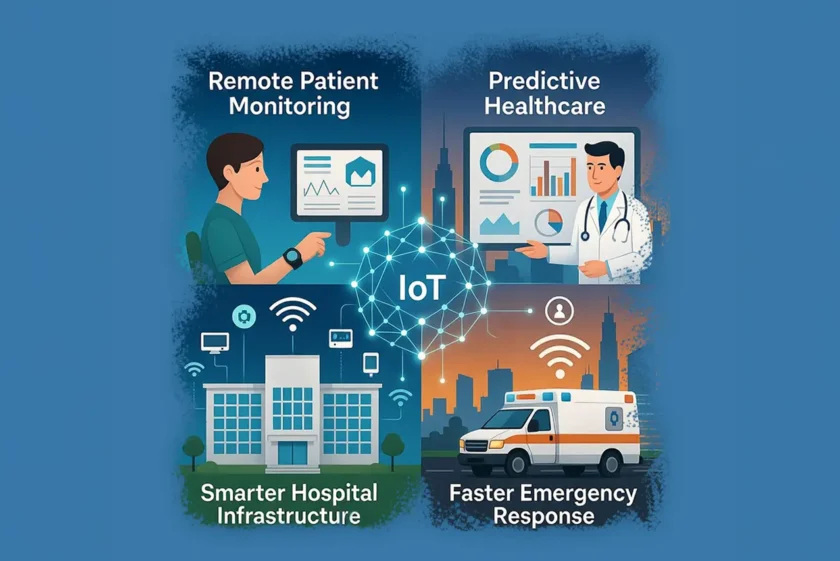
Healthcare in the UAE is undergoing a digital revolution, and at the heart of this transformation lies the Internet of Things (IoT). As hospitals and clinics adopt smart, connected technologies, the country is redefining how care is delivered — enhancing patient outcomes, data management, and operational efficiency. In 2025, IoT isn’t just a technological upgrade; it’s a patient-centric shift toward smarter, predictive, and more efficient healthcare.
The Rise of IoT in UAE Healthcare
IoT technology connects medical devices, wearables, sensors, and hospital systems into one digital ecosystem. This real-time connectivity allows continuous data flow between patients and healthcare providers — from wearable heart monitors to intelligent infusion pumps.
In the UAE, this trend aligns perfectly with government initiatives such as the UAE Vision 2031 and the National Strategy for Artificial Intelligence 2031, both targeting digital transformation in healthcare. Smart hospitals in Dubai, Abu Dhabi, and Sharjah are leading the way, integrating IoT-enabled platforms to track patient vitals, automate administrative tasks, and improve treatment planning through data analytics.
How IoT Is Redefining Patient Care
IoT enhances patient care by making medical services more personalized, timely, and connected. Key benefits include:
Boosting Operational Efficiency Through IoT
Beyond patient care, IoT revolutionizes hospital operations and resource management. In an era where efficiency equals better outcomes, UAE hospitals are leveraging IoT to:
The result: fewer administrative errors, lower operational costs, and a smoother healthcare delivery experience.
Conclusion
IoT is transforming healthcare across the UAE — bridging the gap between patients, providers, and technology. As smart hospitals and data-driven care models evolve, the focus is shifting toward a healthcare ecosystem that’s efficient, personalized, and predictive. The UAE’s vision for 2025 is clear: a world where intelligent connectivity empowers healthier lives and more resilient healthcare institutions.